Showing posts with label Labor economics. Show all posts

Monday, December 6, 2010

Fertility, Earnings and Taxes

The persistence of low fertility rate is one of the many factors inhibiting the stability of public pension systems in developed world. From the 20th century onwards fertility rates have plummeted in all countries that belong to high-income group. The causes of this systematic drop in average fertility rates could be attributed to income affects of higher education and human capital as well es to greater perticipation of women in the labor market. The fertility rate used to stand above average in countries where the dominance of hierarchical religion has been present. Catholic countries such as Ireland, Portugal and Spain were known for extensive influence of religion on fertility decisions regarding the number of children. Thanks to greater use of contraceptive means, the fertility rates in those countries have stadely converged to the level of fertility in Protestant countries. In recent years, the fertility rate in Catholic countries has been ranked at the bottom in high-income country group.

In concidering the features behind lower fertility rate, the influence of taxation of labor supply has been neglected. In Catholic countries, the rate of female participation in the labor market was significantly lower than male labor perticipation rate. The spread of the welfare state in developed countries in the 20th century led to significant spikes in marginal tax rates on labor supply. For instance, 45 percent marginal tax rate implies that from each additional dollar earned, 45 cents go directly to the governement. The implication is that tax burden of labor supply nearing predatory levels does not encourage men and women to spend more time in the labor market. Consequently, the level of earnings decreases in the course of life cycle, further reducing the parental willingness to increase family size.

It is difficult to reverse the tax burden of labor earnings since the continuous growth of the welfare state amassed significant financial labilities of the government. To boost fertillity rate, it is essential to expand incentives to participate in the labor market, postpone labor market withdrawal and increase the family size. Without a prudent reduction of marginal tax rates and effective tax burden of labor supply, the Western world will experience decades of stagnating fertility rates whose negative impact on the stability of public finance could be difficult to reverse.

Saturday, November 27, 2010

The Consequences of Lower Fertility Rate

One of the major challenges that modern world has to face is the reduction of fertility rate. Lower fertility rate leads to demographic imbalances. Demographic pressure on public finance will be enormous since the share of population above the age of 65 is expected to rise rapidly. Western world is undergoing a massive aging of the population. In the 20th and 21sth century, birth rates in Western countries have fallen considerably. Consequently, the share of population 65+ and old-age dependency ratio have increased extensively.

One of the most notable consequences of aging population is an enormous pressure on the long term sustainability of entitlement spending. If public pension and health care systems will not adjust to changes in fertility rate and labor market entry and exit age, an ageing population might easely undermine the ability of public finance to cope with the burden of old-age dependency.

The economic pressure of ageing population will inevitably require the adjustment of tax and spending policies. A growing share of dependent population implies that tax burden disporportionately falls on the working population. The growth of net financial liabilities and current effective tax burden strongly distorts labor supply decisions. Higher implicit tax rate during the working age might easily reduce the fertility rate and keep replacement rates below the demographic equilibrium level. Higher tax burden would then reduce the incentives for having children since the loss of consumption in the working age would stream into prospective periods. In addition, Western countries will have to tackle the issue of early retirement. Empirical evidence suggests that early retirement costs Western countries from 5 percent to 10 percent of the GDP each year.

The growing share of population 65+ leads to changing political landscape. Pension spending would be difficult to reverse if age-dependent population represented a significant share of the voting body. This might trigger the incidence of pensioners' parties in national parliaments which could substantially halt the prospects of pension reform. In any case, age-dependent population would be able to subordinate the preferences of political parties. That would diminsh any plausible possibility of a much needed pension reform.

Tuesday, November 23, 2010

Unemployment rate and economic freedom

Does increasing economic freedom raise the unemployment rate? To answer the question, I collected data on the unemployment rate and Index of Economic Freedom in 2010. I randomly chose 26 countries from various income groups. In the sample are Hong Kong, New Zealand, Switzerland, Australia, Canada, U.S., Denmark, Chile, UK, Netherlands, Spain, Norway, Mexico, France, Turkey, Italy, Tunisia, Brazil, India, Indonesia, China, Russia, Syria, Bolivia, Venezuela and Zimbabwe. Based on the sample data, I estimated the rate of unemployment as a function of economic freedom as measured by the Heritage Foundation.

As it can be seen from the graph, economic freedom does affect the unemployment rate. In fact, the influence of economic freedom accounts for almost 37 percent of the variation in the unemployment rate. Partial regression coefficient suggests that a 1 point increase in the Index of Economic Freedom would reduce the rate of unemployment rate by 0.1452 percentage point. The coefficient is highly significant with p-value equal to 0.001. Thus, one could hardly blame greater economic freedom and labor market deregulation for the rise of the unemployment rate.

Economic Freedom and Unemployment Rate
Source: Index of Economic Freedom, 2010.

Wednesday, October 6, 2010

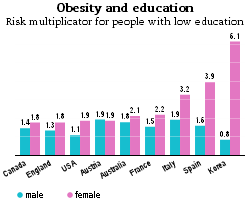
Obesity and employment

A very interesting estimate by the OECD shows that women with low level of education are far more likely than men to become obese.

WSJ posted an interesting article discussing the effect of weight on pay rates in Germany and the United States. The study found that employers treat women in a similar way than fashion industry does; by rewarding very thin women with higher pay. On the other hand, very thin men tend to get paid by $8,437 less than men with average weight. As men pack up their weight, their payroll goes up as well up to the point where they become obese. According to the study, pay-maximizing male weight is 207 pounds (93.89 kg). After that point, the loss of pay and productivity is higher for male than female. The study found that women who weigh 25 pounds (11.34 kg) less than the group norm, earned an average $15,572 more than women of normal weight. Another study found that direct and indirect cost of obesity for women is $4,879 which is about twice as much as for men ($2,646).

Overall, the obesity strongly reduces employment prospects and wage rates for both male and female. It also increases social risk such as exclusion and significantly lower mobility. Obese people find it more difficult to increase the payroll and employment status. This pattern is confirmed both at the theoretical and empirical level.

Friday, September 10, 2010

Spain's labor market reform

According to WSJ (link), Spain has finally implemented the broader reform of the labor market structure. Spain's 20 percent unemployment rate is the highest in the Euroarea. Traditionally, Spain was known for its notorious and heavily regulated labor market. The country used to maintain high levels of minimum wage and high cost of dismissal. The reform introduced by the Zapatero government removed the restrictions for dismissals on a fair basis and deregulated dismissal procedures on indefinite labor contracts. Dismissal cost has been decreased from 45 days to 33 days of salary per year worked.

The labor reform in Spain led to a lot of controversy among economists. Dani Rodrik (link), for instance, claims that labor market deregulation and fewer firing restrictions will further increase the unemployment rate since the major cause of it is the lack of labor demand. On the other hand, a handful of economists claim that Spain's persistent labor market rigidities are the major cause of country's high unemployment rate.

According to World Bank, redundancy cost in Spain averages 56 weeks of wages, more than twice the OECD level. During recessions, the decline in labor demand usually increases the unemployment rate and, therefore, hiring and firing restrictions do not exert the major influence on firm's decisions to employ additional units of labor. However, the persistence of strong labor market regulation imposes significant economic costs.

First, firms do not employ the optimum amount of labor. High redundancy cost and rigid dismissal procedures lead to either under-employment or over-employment of labor. Thus, firms shift the burden of high labor cost on higher prices, lower dividends and lower net wages.

Second, labor market regulation has broader implications. It eventually leads to more institutional rigidities and more pressure on higher wages by trade unions through collective bargaining. Consequently, wages become downward rigid. During the economic recovery, firms are therefore less motivated to employ new workers or extend the existing labor contracts.

As Spain finally recovered from the recession, the ongoing labor rigidity and even the increasing labor demand could not alleviate Spain's high unemployment rate. It would only put more pressure on Spain's government to increase government spending on unemployment schemes. Therefore, the reform of the labor law based on labor market flexibility is the most plausible alternative for Spain to boost employment and decrease the widening budget deficit that threatens country's economic recovery.

Wednesday, July 14, 2010

Benefits of immigration

The Economist wrote an interesting article on the significance of migration and important spillovers from immigration into developed countries. The economic crisis of the past year has slowed the flow of international migration. As the estimate from Migration Policy Institute suggests, the stock of illegal immigrants in America fell from 12.1 million in July 2008 to 11.9 million in the year after. It is important to emphasize the economic benefits of migration for developed and developing countries.

The migration to developed countries has resulted in higher employment and greater specialization in the labor market. Without the flow of migrants the structure of the labor market in developed countries would incentivize workers to take lower paid jobs which would result in lower incomes. As the developed countries opened their borders to immigrants from all over the world, young individuals were enabled to invest in human capital and by doing so increase their career prospects. As for developing countries, migrants increase the stock of human capital availible to the country of migrant's origin. Therefore, immigration from less developed countries should not be seen as a loss but as an immense opportunity to get the know-how and high skills through which the country of migrant's origin shall prosper. The widespread emergence of technologies such as Google's applications, Twitter, Facebook, Linkedin etc. has further enhanced the flow of knowledge and information to the countries of migrant's origin. It should not be neglected that economic catch-up, generated from technological imitation, is the only way for less developed countries to reach the income per capita of their richer peers.

The OECD published a report where it estimated that the inflow of migrants to rich countries fell by 6 percent in 2008, to 4.4 million. Five years before 2008, the inflow of migrants soared. The main benefit of immigration is more favorable demographic outlook since developed countries will experience sharp increases in the share of older population (65 years and over), replacement rate and fiscal burden of entitlement spending. The inflow of immigrants not only benefits the labor market but it also boosts incentives to work, save and invest since immigrants work longer hours and retire later than native population. Therefore, immigration should not be discarded but encouraged and promoted by national governments.

Friday, July 9, 2010

The impact of crisis on employment

In recent days, Greek public sector workers have launched protests against government austersity measures which include a cutback in minimum wages, public pensions, an increase in effective retirement age and a cut in entitlements. An interesting question is how the crisis affected employment outlook across the world. The OECD recently presented a brief overview of unemployment dynamics in member states (link).

The countries, least affected by the crisis in terms of unemployment surge, are the ones with strong and flexible institutional foundations of the labor market such as the flexibility of wages, the ease of firing and hiring, tax wedge and the linkage between productivity and wage rates. These countries are, for instance, Austria, The Netherlands, Korea and Norway. The surge in unemployment has been the most significant in countries such as Spain, Ireland, U.S. and Iceland where the banking and financial crisis have torn real income and employment by heavy spillover of financial shock into the real sector. It is important to emphasize that long-term employment outlook in OECD countries will be determined by wage flexibility and regulatory environment which is essential and conducive to job creation besides economic growth and unit labor costs.

Friday, May 14, 2010

Productivity gap between the US and OECD countries

I collected data from the OECD on GDP per hour worked in each country as a percentage of the US level. The highest level of GDP per hour was found in Luxemburg (140.4 percent of the US level), Norway (136 percent of the US level) and the Netherlands (100.4 percent of the US level). In these countries, the level of productivity is higher as the workers there work fewer hours per year than in the US, so it is no surprise that relative productivity is higher. The least-performing countries are Poland (37.9 percent of the US level), Mexico (33.6 percent of the US level), and Chile (28 percent of the US level). These countries are catching-up developed nations, so in spite of relatively high number of working hours per year their level of productivity is significantly lower.

In the long run, productivity is the only engine of economic growth and the wealth of nations. It is the only hope for less-developed and developing nations to catch the income per capita level of advanced countries. There are many obstacles to higher productivity in the labor market. First, many countries impose minimum wage laws, risking higher unemployment among less-skilled workers. Minimum wages increase labor costs and reduce overall employment. Second, the number of working hours is often restricted by trade union determination of labor contracts and entry requirements in many sectors. Third, some countries reduce labor supply incentives through higher hourly wages on extra working hours so that employers do not encourage employees to work longer hours. And fourth, high marginal tax rates discourage workers from longer work. A reduction in marginal tax rates, the abolition of minimum wages, deregulation of entry requirements and tax incentives for extra hours of work could significantly boost productivity growth and higher standards of living.

GDP per hour in OECD countries
Source: OECD (2010)