Showing posts with label Health. Show all posts

Wednesday, October 6, 2010

Obesity and employment

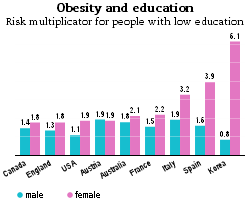
A very interesting estimate by the OECD shows that women with low level of education are far more likely than men to become obese.

WSJ posted an interesting article discussing the effect of weight on pay rates in Germany and the United States. The study found that employers treat women in a similar way than fashion industry does; by rewarding very thin women with higher pay. On the other hand, very thin men tend to get paid by $8,437 less than men with average weight. As men pack up their weight, their payroll goes up as well up to the point where they become obese. According to the study, pay-maximizing male weight is 207 pounds (93.89 kg). After that point, the loss of pay and productivity is higher for male than female. The study found that women who weigh 25 pounds (11.34 kg) less than the group norm, earned an average $15,572 more than women of normal weight. Another study found that direct and indirect cost of obesity for women is $4,879 which is about twice as much as for men ($2,646).

Overall, the obesity strongly reduces employment prospects and wage rates for both male and female. It also increases social risk such as exclusion and significantly lower mobility. Obese people find it more difficult to increase the payroll and employment status. This pattern is confirmed both at the theoretical and empirical level.

Monday, June 21, 2010

Taxing soda drinks and fast food

In the U.S., average Body Mass Index (BMI) for men is 26, one point above the critical level. Given widespread growth of childhood obesity, policymakers in Washington have pondered the idea of levying a tax on soda drinks and fast food. The consumption of these products has negative impact on bystanders. Moreover, due to obesity, insurance premiums and costs of health care are rising. Each year, childhood obesity raises insurance premiums by $147 billion. In addition, childhood obesity is likely to become the major source of future growth of Medicare costs. Although the obesity pattern is the strongest and most significant in the U.S., Europe is not immune to widespread childhood obesity. The highest percentage of overweight children in Europe was found in Spain, Greece, Germany and in the UK. In general, obesity rates in Europe are catching up the U.S. level.

Academic studies have shown that the major factor of obesity among children and adults is excess availibility and low prices of soda drinks and fast food. In addition, large exposure of vending machines in schools also contributes to obesity through the consumption of candies and other high-calory products. For instance, an interesting study has examined the effect of vending machines on body weight. It showed that people with direct access to vending machines in schools and workplace gained cca. 3 kg more than those without access to vending machines. Therefore, is a tax on soda drinks and fast food a viable way to contain the growth of obesity?

Greg Mankiw has presented the economic point of view in NY Times (link). Generally speaking, the demand for soda drinks and fast food is price elastic, which means that a 1 percent decrease in the price of soda drinks would increase soda drink consumption by more than 1 percent. If government policymakers introduced a tax on soda drinks (fast food included), the burden of the tax would shift entirely on consumers who would pay the eventual cost of health care arising from obesity as a consequence of excessive consumption of soda drinks and fast food. That is why such a tax is feasible. There is no reason why the society should bear the burden of obesity through higher tax burden and rising cost of health care delivery. This is the most obvious evidence how society pays for private action that should be tackled by individuals themselves.

Wednesday, May 19, 2010

US health expenditures

The US has the highest percentage of health expenditure in OECD countries. The finding is surprising given the fact that the role of government in US health care delivery is among the smallest in the world. However, health insurance in the US is conducted through insurance companies and not directly between the patient and health-care provider. Such interaction creates the third party payer problem. Much of the health insurance in the US is provided through employer mandates. Such a scheme entitles employers to buy health insurance on behalf of employees via insurance company. The scheme, due to the lack of direct payment, creates the so called moral hazard, giving employees incentives not to provide themselves with full insurance coverage. Average American spends $7.250 on health per year, which is more than two and half times the average expenditure in the OECD ($3.000).

The US health-care reform should focus on deregulation of health insurance market across the country. The provision of free interstate health insurance market would force insurance companies to cut predatory premiums and end insurance denials to their customers. In addition, health-care reform should encourage out-of-pocket payments given the fact that these payments are strongly correlated with overall health conditions. Switzerland enjoys one of the highest life expectancies in the world alongside very high out-of-pocket payments for health care. The US should move in the direction of elimination of employer provided health insurance. This step would gradually reduce the size of health expenditures and would also contribute to the reduction of the number of uninsured.

Health Expenditures in the OECD
Source: OECD (2010)

Saturday, May 15, 2010

Children living in one-parent households

Evidence suggests that living in one-parent household increases the probability of child poverty. In the OECD, 85 percent of single-parent households are headed by women. The highest percentage of single-parent households prevails in English-speaking countries (US, UK, Canada and New Zealand). The highest proportion of children aged 14 or below and living in one-parent household was found in the US (25.8 percent), Estonia (24 percent), the UK (22.9 percent). The lowest proportion was found in Portugal (9.8 percent), Italy (9.2 percent) and Greece (7.4 percent). It seems that the proportion is closely related to the religious pattern of the society, meaning that more traditional societies emphasize long term marriage and matrimony stability. The issue deserves more attention as the childrens' wellbeing, earnings and state of health are, in a large part, determined in early childhood.

The proportion of children living in one-parent households
Source: OECD (2010)

Saturday, May 8, 2010

How farm subsidies kill Europeans

Cardiovascular diseases (CVDs) are the main cause of deaths in the Europe, approximately 49 percent of all deaths, out of which 30 percent of all premature deaths before the age of 65. Cardiovascular diseases are estimated to cost the EU €169 billion every year.

Let take a look at the data. In Germany, 907 men and 237 women on average die prematurely each year before the age of 75 due to coronory heart diseases (CHD). In the UK, 479 men and 1453 women die each year due to premature death alone. The number of premature deaths is high in Mediterranean countries (Italy, Spain) as well. In Italy, 233 men and 826 women die because of the premature death (link).

"The school milk subsidy scheme introduced by the European Commission likewise means that a child drinking full-fat rather than skimmed milk will consume an additional 1.5 kg of saturated fat every year approximately 4 g per day. British children obtain 23% of their daily saturated fat intake from full-fat milk (link)."

To prevent premature deaths in Europe, European policymakers should impose a tax on the products causing significant health problems such as diabetes, obesity, lung cancer, incresing blood pressure, raising cholesterol etc., and by doing so save more lives. The EU Common Agicultural Policy (CAP) annual budget represents approximately €45 billion which represents 45 percent of the overall EU budget. Through subsidies and direct payments, CAP is a source of massive oversupply and overproduction of dairy products. These products are the main source of excessive butter and full-fat milk consumption which further leads to raising cholesterol, coronary heart diseases, incresed blood presure etc. The CAP has a deadly cost - human lives.